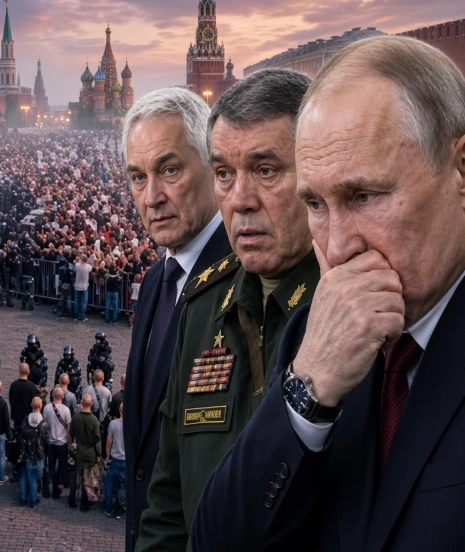
Russia’s top military commanders and civilian leadership are increasingly at odds over whether to expand troop mobilization to maintain momentum in the Donbas, according to reports suggesting that military pressures and domestic political calculations are driving a rare public division within the Kremlin’s inner circle.
The reported divide centers on how Moscow sustains its military campaign as costs mount both on the battlefield and within the state budget. Chief of the General Staff Valery Gerasimov has reportedly pushed for a broader conscription order to replenish personnel losses, while Defense Minister Andrei Belousov and other civilian officials have resisted the expansion, citing concerns about economic and social consequences. The specific details of these discussions remain unverified and have not been independently confirmed by multiple sources.
What Happened
Military officials have signaled that expanded mobilization would address acute personnel shortages. Reports indicate that Russia has absorbed an estimated 54,400 casualties in October alone, a figure that underscores the intensity of fighting in eastern Ukraine. These losses have created recurring gaps in frontline units that current recruitment and voluntary contract signings have struggled to fill.
Civilian officials and the Kremlin have expressed reservations about a wider call-up, citing potential backlash within Russian society. A formal mobilization announcement could trigger the kind of public resistance seen during earlier conscription drives, particularly in regions where household income and economic stability already depend heavily on military spending.
The Reaction
The reported tensions reflect competing institutional interests within Russia’s power structure. The military establishment views expanded mobilization as a tactical necessity to maintain operational capacity, while financial officials worry about cascading economic effects. Some accounts suggest that budget pressures—including possible delays in military salary payments and accelerated sales of gold reserves—indicate strain on Moscow’s ability to sustain wartime spending indefinitely.
The disagreement also arrives amid broader regional stress, with reports indicating that more than 60 regions face financial difficulties related to wartime commitments. These conditions have elevated the political cost of any new mobilization order.
What This Means
The apparent disagreement signals that Russia faces genuine constraints—both human and financial—on its ability to prosecute the war without making politically costly choices. A major mobilization could supply additional combat personnel but would almost certainly intensify domestic criticism and further strain an economy already heavily committed to military operations.
The Kremlin’s hesitation to authorize broader conscription, if accurately reported, suggests that political calculations about domestic stability are increasingly competing with military demand. The outcome of this internal debate will likely shape both the trajectory of fighting in the Donbas and Russia’s diplomatic posture in any future negotiations.



