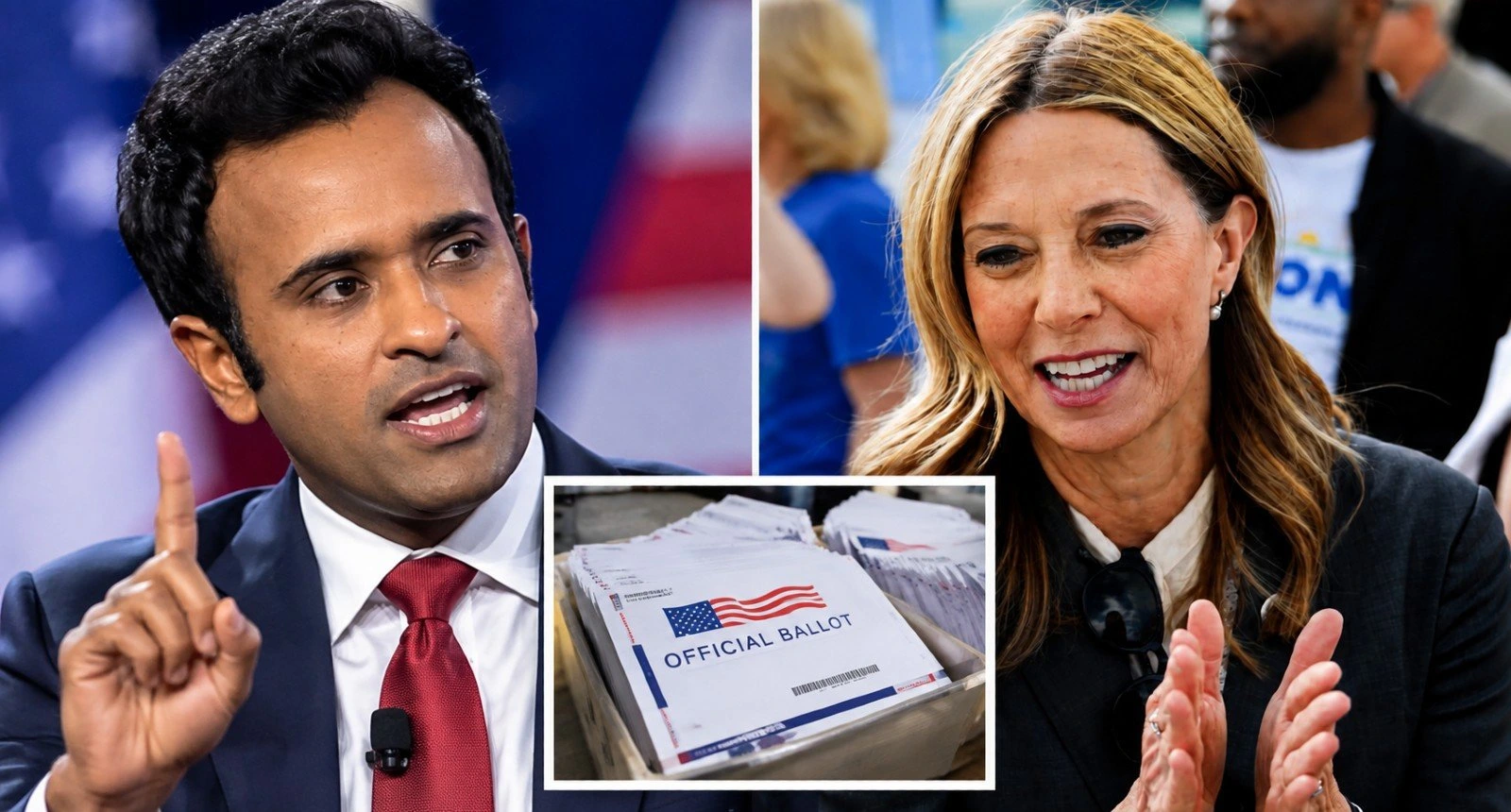
An election analyst’s October 22 update on Ohio’s early voting showed Republicans holding a 108,240-ballot advantage among roughly 838,000 early and mail votes counted, as the state’s closely watched Senate race between Republican Jon Husted and Democrat Sherrod Brown draws national attention and funding.
Election analyst E DataGuy released voting estimates Thursday based on classified early and mail ballots in Ohio. The data snapshot, covering 838,018 ballots, assigned 469,219 to Republicans and 360,979 to Democrats, with the remainder unclassified.
What Happened
DataGuy’s modeling indicated Republicans held a “firewall” advantage of 108,240 ballots in the early voting period. The analyst projected a Republican vote share ranging from 52 to 58 percent, compared with a Democratic range of 41 to 47 percent, while estimating overall turnout at 55 percent.
The analyst characterized the race as “leaning Republican,” a classification based on modeling of ballot returns rather than a final election result. The methodology underlying the partisan vote classifications relies on statistical modeling but was not fully detailed in the public update.
Husted, a Republican senator, entered the race after Vice President JD Vance vacated the seat. He faces Sherrod Brown, the longtime Democratic incumbent, in a matchup that has attracted substantial national funding and attention from both parties.
The Reaction
Republican political organizations have channeled significant financial resources into the final phase of the campaign. President Donald Trump’s flagship super PAC, MAGA Inc., began September with roughly $416 million available, according to federal filings reviewed by news organizations.
MAGA Inc. transferred $200 million to No Going Back PAC and $25 million to Safety and Affordability PAC during the cycle. As of October 14, the super PAC retained more than $164 million, with Trump-aligned groups having spent nearly $277 million since September across coordinated transfers and direct spending.
Republican national party committees reported strong financial positions heading into the final weeks. Three major Republican committees held $187 million in cash at the end of September, Reuters reported, compared with weaker Democratic committee cash reserves and substantially higher spending on coordinated campaign activities.
The National Republican Congressional Committee separately announced $50 million raised during the third quarter, bringing its full-cycle fundraising to approximately $250 million. The NRCC entered October with $61 million on hand, though those resources are primarily directed toward House races rather than Husted’s individual Senate campaign.
Major Republican donors identified in campaign finance disclosures included Elon Musk, Diane Hendricks, Stephen Schwarzman, and Steve Wynn. A June Supreme Court ruling expanded coordinated spending opportunities that Republican committees have deployed more aggressively than Democratic counterparts.
What This Means
The early voting snapshot provided by DataGuy offers a single-point estimate rather than a forecast of final results. Early voting margins in a state do not guarantee ultimate electoral outcomes, and final ballots cast on Election Day remain uncounted.
Ohio’s Senate race will ultimately be decided by total votes tallied after Election Day, not by modeling of mail and early ballots released weeks before polls close. The state has supported Republican presidential candidates in recent cycles, although statewide Senate contests have remained competitive.
The combination of modeling data and substantial Republican financial deployment entering the final campaign phase suggests a closely contested race where both parties view the outcome as consequential beyond Ohio’s borders. Actual results will depend on voter turnout, ballot composition, and Election Day voting patterns.



