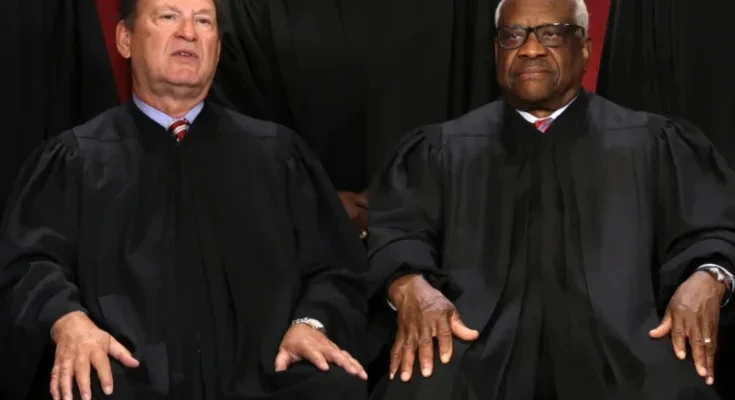
Justice Clarence Thomas and Samuel Alito dissented Tuesday after a majority of the Supreme Court declined to hear a lawsuit in which Florida alleged that California and Washington violated federal commercial driver’s licensing standards by issuing licenses to undocumented immigrants, potentially compromising road safety.
Florida’s case centered on a fatality involving a truck driver who the state said lacked adequate English proficiency to read road signs. The justices’ dissent underscored a fundamental disagreement over the court’s constitutional role in resolving disputes between states—a jurisdiction that falls exclusively to the Supreme Court under the nation’s governing document.
What Happened
Florida brought the dispute to the Supreme Court, contending that California and Washington had improperly issued commercial driver’s licenses to individuals lacking lawful immigration status and sufficient English language skills. The state argued that federal law and regulations explicitly prohibit states from issuing such licenses without proof of appropriate immigration status and demonstrated English comprehension. The licensing practices, Florida alleged, created an unsafe condition on American highways.
In his dissent, Thomas wrote that the court had a constitutional obligation to exercise jurisdiction because disputes between states can only be adjudicated at the Supreme Court level. “If this Court does not exercise jurisdiction over a controversy between two States, then the complaining State has no judicial forum in which to seek relief,” Thomas said in his written opinion.
Thomas emphasized the constitutional principle underlying the court’s exclusive jurisdiction. “We have no more right to decline the exercise of jurisdiction which is given, than to usurp that which is not given,” he wrote, citing foundational doctrine on the separation of powers and the Constitution’s design.
The Reaction
Thomas and Alito’s dissent highlighted the gravity of the case’s facts. Thomas pointed to a fatal highway crash involving truck driver Harjinder Singh, noting the driver’s inability to read English-language road signs. He argued that the Supreme Court’s refusal to hear the case left Florida without recourse to seek judicial remedy for what the state characterized as a threat to public safety.
The dissent stressed the federal statutory framework governing commercial licensing. Federal law requires that applicants pass a driver’s test, demonstrate sufficient English language proficiency, and show appropriate immigration status before obtaining a commercial driver’s license. The two states’ policies, according to Thomas and Alito, circumvented these requirements.
What This Means
The majority’s decision to reject the case leaves unresolved whether states may unilaterally modify federal licensing standards in ways that override uniform federal requirements. The outcome reflects a broader tension on the court regarding the scope of its original jurisdiction—the category of cases that begin and end at the Supreme Court rather than moving up through lower courts.
Thomas and Alito’s dissent raised questions about the practical implications of declining to hear inter-state disputes. Without a Supreme Court forum, states arguing that peer states have breached federal standards or caused injury through non-compliance may lack a meaningful avenue for judicial redress. The dissent suggested that the majority’s approach potentially weakened the Constitution’s mechanism for mediating conflicts between sovereign states, a function the framers intended the Supreme Court to perform.
The case signals ongoing disagreement within the court over how broadly it should exercise its original jurisdiction, particularly when federal regulatory uniformity and public safety emerge as the central issues dividing states.



