Maine Republican Sen. Susan Collins voted with Senate Democrats this week on a procedural motion to recommit a $70 billion budget reconciliation package to the Senate Judiciary Committee for further investigation into insurance company practices that allegedly deny or delay medically necessary care to patients.
Collins’ decision placed her at odds with most Senate Republicans, who opposed the delay and argued the legislation should continue through the legislative process without additional committee review. The amendment, offered by Sen. Jon Ossoff (D-Ga.), sought to redirect the reconciliation package to examine allegations that insurance companies have improperly blocked medical treatment and coverage.
What Happened
On the Senate floor, Ossoff introduced the motion with direct language about the stakes. “Let’s ban insurance companies from denying or delaying medically necessary healthcare to Americans,” he said. Ossoff cited a constituent diagnosed with multiple myeloma, a rare blood cancer, who encountered obstacles when seeking insurance coverage for her medical care.
“Across America, insurance companies continue to deny and delay medically necessary healthcare,” Ossoff added. His motion mirrored an earlier proposal during the April Senate budget resolution, which had similarly aimed to create a point of order against any budget reconciliation bill that failed to address insurance company denials or delays of care.
Collins was not the only Republican who had previously aligned with Ossoff on this issue. Sen. Dan Sullivan (R-Alaska) and Sen. Josh Hawley (R-Mo.) had both voted to support Ossoff’s amendment in April. This time, however, both Sullivan and Hawley voted against it.
Had Ossoff’s motion succeeded, it would have blocked the $70 billion reconciliation bill, which would allocate funding for Immigration and Customs Enforcement and Border Patrol through 2029 if signed into law by President Trump.
The Reaction
Collins’ vote came amid significant personal and professional transition. She conceded her re-election race earlier this month to Democrat Troy Jackson, ending a Senate career that began in 1996. Collins had sought a sixth term and served as Maine’s longest-tenured member of Congress, with nearly three decades in Washington.
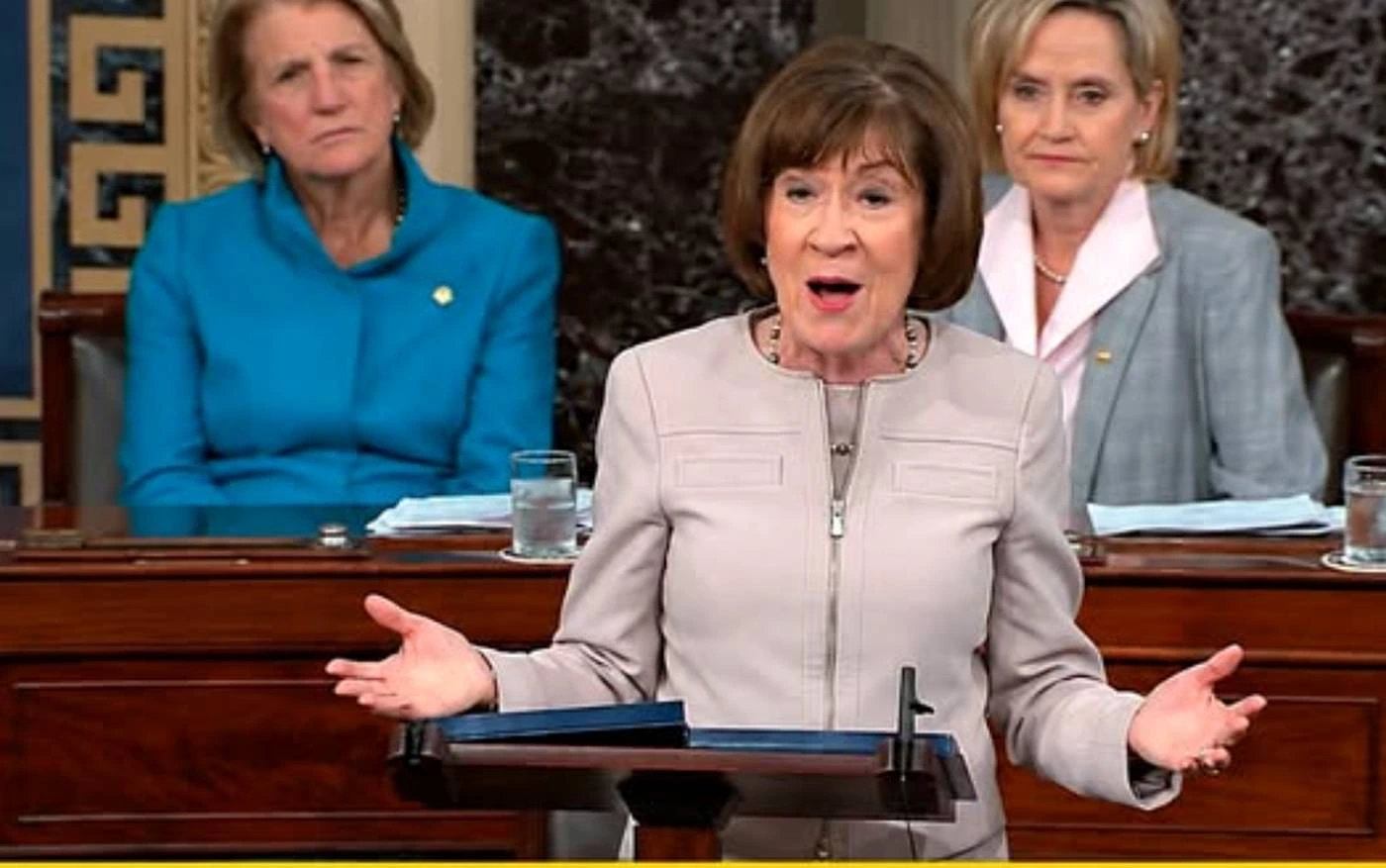
“It has been the honor of my life to serve the people of Maine in the United States Senate,” Collins said. She confirmed she had contacted Jackson to congratulate him and committed her staff to ensuring a smooth transition.
Her departure carries real consequences for Republican leadership. Collins had chaired the Senate Appropriations Committee, one of the chamber’s most influential posts overseeing federal spending. She had frequently emphasized that her seniority and committee role provided Maine with leverage in securing federal resources and advancing state priorities.
Jackson, a fifth-generation logger and former Maine Senate president, campaigned as a working-class Democrat with strong ties to organized labor. After his election became official, he wrote on social media: “Maine, I owe you everything.” He pledged to honor his roots and the rural communities and workers he planned to represent.
Jackson’s path to the ballot was complicated. He replaced Democratic nominee Graham Platner in July after Platner withdrew following sexual-assault allegations. The Maine Democratic Party voted to install Jackson as the replacement nominee, effectively resurrecting the party’s Senate prospects after the original campaign had collapsed.
During his compressed campaign, Jackson faced personal controversy when reports emerged that his partner, the mother of his children, was also his second cousin. According to those accounts, the couple share great-grandparents. Despite the obstacle, Jackson defeated Collins in a state that has grown increasingly favorable to Democratic presidential candidates in recent election cycles.
What This Means
Collins’ vote on the insurance amendment signals the complex cross-party dynamics that persist on healthcare accountability issues, even as party divisions harden elsewhere. The fact that two Republicans who supported Ossoff’s motion in April switched positions this week underscores how procedural votes and high-stakes reconciliation bills can shift political calculations.
The incoming transition in Maine’s Senate seat marks a generational shift in the state’s representation, with the departure of one of the longest-serving Republican moderates and the arrival of a legislator rooted in labor and rural constituencies. How that transition reshapes Maine’s influence on federal spending and appropriations remains to be seen as the new Congress prepares to convene.



