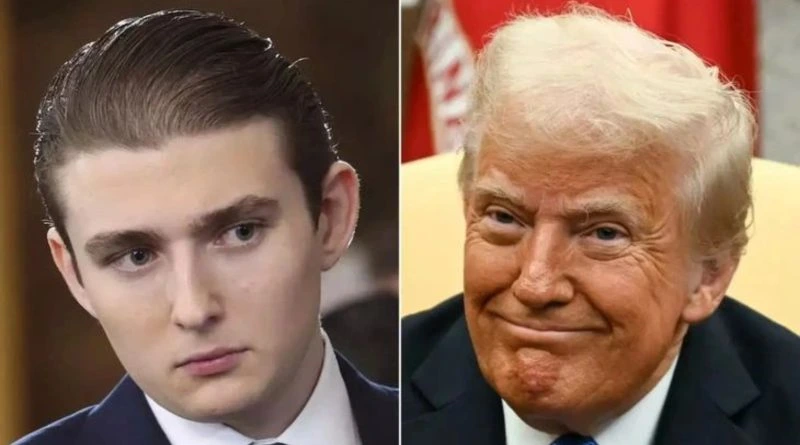
Barron Trump, the eldest son of former President Donald Trump, became the subject of rapid online speculation after a cryptic headline circulated across social media platforms, underscoring how his carefully guarded private life fuels public curiosity whenever his name surfaces.
The headline’s vague phrasing—omitting key details—prompted thousands of users to share and discuss the post before understanding its full context. The pattern reflects a broader dynamic in digital media: when a figure remains largely unseen and unheard from, any mention of their name commands disproportionate attention.
What Happened
For much of his life, Barron Trump has maintained an extraordinarily low public profile compared to other children of prominent political families. He has rarely granted interviews, made sparse public appearances, and has been deliberately shielded from the kind of media exposure typical of political dynasties. That strategic privacy has created an unusual situation—his name is instantly recognizable, yet his personality and views remain largely unknown to the broader public.
When a headline involving him circulated online, social media users immediately began speculating about its meaning. “Barron is probably the most mysterious member of that family,” one commenter wrote. “Any time his name shows up in a headline, people instantly click.” Another added, “He’s been kept so private for so long that even the smallest update turns into a huge story.” The ambiguity of the original post meant readers filled information gaps with assumptions, creating a cascade of shares before clarification could spread.
The Reaction
The online conversation revealed frustration with clickbait tactics targeting public figures, particularly those who have not sought media attention. Many users criticized the deliberately vague framing, arguing it exploited emotional curiosity rather than conveying substantive information. “People need to stop using young public figures for clickbait,” one user wrote. “If there’s no real information, don’t make it sound like a crisis.”
That sentiment reflected broader concern about Barron’s treatment by internet culture. Unlike adult political figures who voluntarily enter the public sphere, Barron has largely been viewed as someone who did not choose prominence. Some argued his age and limited public activity warranted greater media restraint and protection from sensationalism.
What This Means
The episode illustrates a fundamental shift in how digital media operates around political families. Public fascination with Barron stems not from active public engagement but from rarity and absence. As he transitions into adulthood, curiosity naturally increases among those who remember him as a child in the White House. His silence, paradoxically, amplifies attention whenever it is broken.
The broader symbolic factor also matters. In American culture, children of major political families often become subjects of projection and cultural storytelling. They are viewed not solely as individuals but as extensions of narratives that millions feel invested in. For Barron, that dynamic has been complicated by his withdrawal from public view, making each unexpected mention feel amplified by contrast.
This moment serves as another reminder of how internet culture converts uncertainty into sustained conversation—particularly when the name attached carries historical and political weight. The attention surrounding Barron Trump persists regardless of substantive public statements from him, driven instead by silence, rarity, and the enduring curiosity that attaches to anyone connected to one of America’s most scrutinized families. As digital media continues evolving, the tension between privacy expectations and public interest will likely remain unresolved, especially for figures like Barron who occupy an unusual space between recognition and obscurity.