A popular election forecasting channel on YouTube asked ChatGPT to simulate the 2028 U.S. presidential race, and the artificial intelligence model produced a detailed state-by-state prediction showing Vice President JD Vance defeating California Governor Gavin Newsom in a race for the White House.
The simulation presented an Electoral College map filled in by poll-closing times, complete with projected vote margins and a final tally of 326 electoral votes for Vance compared to 212 for Newsom. The video has sparked renewed discussion about possible matchups heading into the next presidential cycle.
What Happened
The Election Time channel host began by asking ChatGPT to first select the likely Democratic and Republican nominees for 2028. The AI model chose Newsom on the Democratic side, despite polling at that time showing him trailing former Vice President Kamala Harris by roughly 15 points. For Republicans, the choice was straightforward—the model selected Vance, citing his standing in preference markets and early polling data.
Once the matchup was set, ChatGPT then walked through the election night scenario hour by hour, projecting results as polls closed across different time zones. The simulation began with the 7 p.m. Eastern closings, when Georgia, Indiana, Kentucky, South Carolina, Vermont, and Virginia report results. In this scenario, Indiana and Kentucky went solidly Republican, while Georgia tilted toward Vance by 4 points—described as doubling former President Donald Trump’s margin there in 2024.
By 7:30 p.m., West Virginia was called solidly for Vance with a more than 40-point margin, and Ohio leaned Republican by 14 points. The massive 8 p.m. wave, covering 171 electoral votes across 16 states, included a significant Republican gain: New Hampshire went lean Republican by 0.9 percent, marking the first Republican victory there since George W. Bush in 2000.
Pennsylvania, Florida, and other traditional competitive states moved into the Republican column or lean Republican in the forecast. By the end of that hour, Vance had accumulated 178 electoral votes and stood fewer than 100 votes shy of the 270 needed to win.
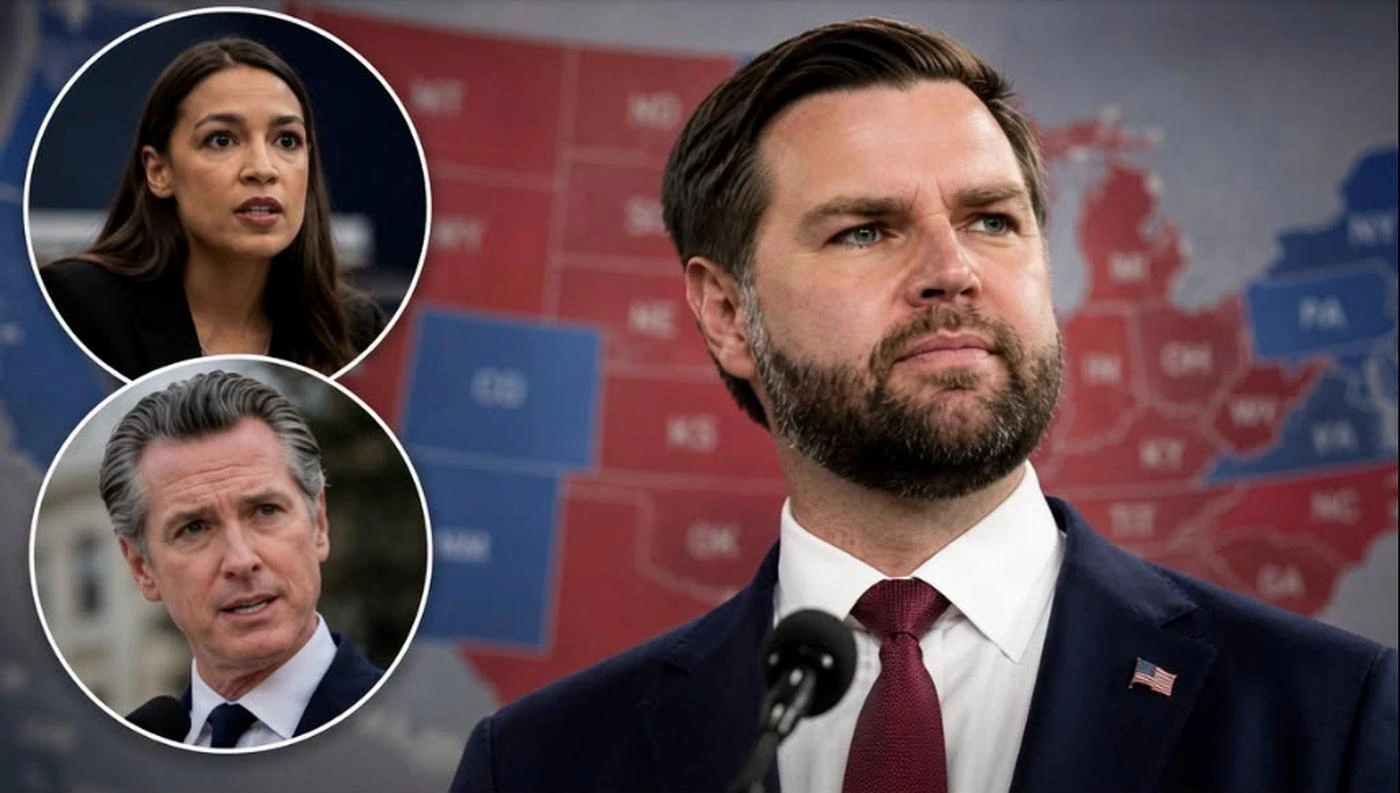
The 9 p.m. closings delivered what the host described as historic flips. Minnesota went lean Republican by 1.2 percent—the first Republican to carry the state since Richard Nixon in 1972, according to the simulation. Wisconsin and Michigan both leaned Republican by 2 to 4 points each, as did Arizona and Nevada. Meanwhile, Newsom held New York, Colorado, and New Mexico, along with the entire West Coast.
The Reaction
The video gained viral attention as viewers engaged with the premise of an AI election simulation. The prediction generated discussion about how artificial intelligence models approach hypothetical scenarios and the underlying data they use to generate forecasts. Some viewers treated the simulation as a curiosity about AI reasoning, while others debated whether the margins and state calls reflected realistic political dynamics.
Market-based prediction platforms like Kalshi were referenced in the video as supporting data for the nominee selections. The host noted that Newsom held a 19 percent implied probability of winning the Democratic primary according to those markets, while Vance held a 41 percent probability on the Republican side at the time the video was made.
What This Means
The simulation illustrates how AI language models can be prompted to generate detailed hypothetical scenarios based on existing polling data, historical patterns, and market signals. ChatGPT’s prediction placed Newsom’s hypothetical performance below even Michael Dukakis’s 1988 loss, suggesting the model weighted certain demographic and regional shifts heavily in favor of Republicans.
As a forecasting tool, the exercise shows both the potential and limitations of AI in political prediction. While the model could draw on historical voting patterns and current data, it operates within constraints and assumptions that shape its output. Election forecasting ultimately depends on factors that remain unknowable—shifts in candidate viability, unexpected events, voter turnout variations, and late-breaking developments all influence actual outcomes in ways no model can fully anticipate.



