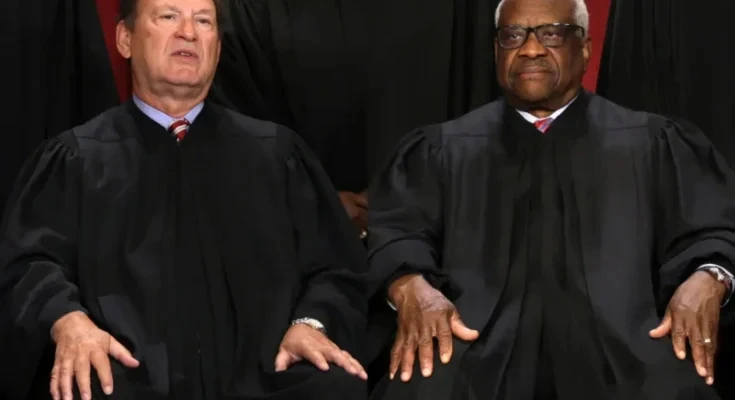
Justice Clarence Thomas and Justice Samuel Alito on Tuesday objected to the Supreme Court’s refusal to hear a lawsuit filed by Florida against California and Washington over commercial driver’s licenses issued to undocumented immigrants, with Thomas arguing the high court had a constitutional obligation to resolve disputes between states.
The case centered on Florida’s allegation that California and Washington violated federal commercial licensing standards by issuing driver’s licenses to individuals without lawful immigration status or sufficient English proficiency. The complaint linked the policies to a fatal highway crash involving a truck driver who authorities said could not read road signs.
In his written dissent, Thomas emphasized that the Supreme Court stands as the only forum where one state can bring legal claims against another. “If this Court does not exercise jurisdiction over a controversy between two States, then the complaining State has no judicial forum in which to seek relief,” he wrote.
What Happened
Florida brought the suit arguing that Washington and California had created a public safety hazard by issuing commercial driver’s licenses to people without demonstrating English proficiency or immigration status, contrary to federal standards. The state referenced a deadly truck accident in which the driver involved was unable to read road signage, framing the dispute as one with direct consequences for highway safety.
Federal regulations require that applicants for commercial driver’s licenses pass a skills test, demonstrate sufficient English comprehension, and provide proof of lawful immigration status. Thomas noted that such requirements exist specifically to ensure road safety for the millions of Americans who share highways with commercial vehicles.
The Supreme Court majority declined to accept the case, effectively dismissing Florida’s claims without a hearing on the merits. Thomas, writing in dissent and joined by Alito, objected strenuously to the decision.
The Reaction
Thomas argued that the court’s discretion in accepting cases for review operates differently when disputes arise between states rather than in typical appellate matters. He cited constitutional principle and historical practice, writing: “We have no more right to decline the exercise of jurisdiction which is given, than to usurp that which is not given.”
The dissent underscored the unique position of inter-state disputes in Supreme Court jurisdiction. Unlike private citizens or businesses that may seek redress in lower courts, a state asserting claims against another state has no alternative legal venue. The rejection of Florida’s case therefore left the state without recourse, Thomas contended.
Alito joined Thomas’s position but did not file a separate statement. No other justice issued a dissent.
What This Means
The court’s action leaves unresolved questions about whether states may unilaterally override federal licensing standards without facing legal challenge. The decision also clarifies that a majority of current justices viewed the case as unsuitable for the court’s docket, even though it involves direct conflict between states on a matter of federal law.
For Florida, the ruling forecloses the primary legal avenue available to states seeking to hold peer states accountable for policies it deems harmful. Looking forward, the case illustrates ongoing tension within the court over the scope of its original jurisdiction and the balance between judicial restraint and the resolution of inter-governmental disputes.



