The Supreme Court of the United States delivered a unanimous legal victory to the Trump administration this week by reversing a federal appeals court decision that had reopened a dispute over speech restrictions imposed on federal immigration judges.
In an unsigned order, the justices overturned a Fourth Circuit Court of Appeals ruling and reinstated a lower-court dismissal of a lawsuit filed by the National Association of Immigration Judges. The case centers on a Justice Department policy requiring immigration judges to seek approval before participating in certain public speaking engagements classified as “official” in nature.
What Happened
Under the contested policy, immigration judges must obtain authorization to speak at venues including immigration conferences and pro bono legal training sessions. Court records show judges retain the ability to deliver speeches in their personal capacity, provided the topics do not directly address immigration policy or employment matters within their agency.
The immigration judges’ association initially challenged the policy in federal court in Alexandria, Virginia, contending it violated their First Amendment rights by preventing them from expressing private views on immigration matters or their employer. U.S. District Judge Leonie Brinkema, appointed during the Clinton administration and serving the Eastern District of Virginia, dismissed the lawsuit by determining that Congress had intended such claims to proceed through the Civil Service Reform Act’s specialized review framework rather than traditional federal court litigation.
The Fourth Circuit later revived the case and remanded it to district court, expressing concerns about whether the Congressional review structure actually functioned as intended. The appeals court identified two systemic problems: the Merit Systems Protection Board had experienced periods without sufficient members to operate, creating backlogs that observers said undermined the system’s effectiveness, and the Trump administration’s stated legal position that the president may remove MSPB members and Office of Special Counsel officials at will raised questions about the independence of federal employee oversight mechanisms.
The administration petitioned the Supreme Court, characterizing the case as a “clear candidate for summary reversal” and arguing the Fourth Circuit had adopted a legal theory the parties had not presented. Justice Clarence Thomas, joined by Justice Amy Coney Barrett in a separate writing, stated the appeals court had also erred on the underlying legal questions.
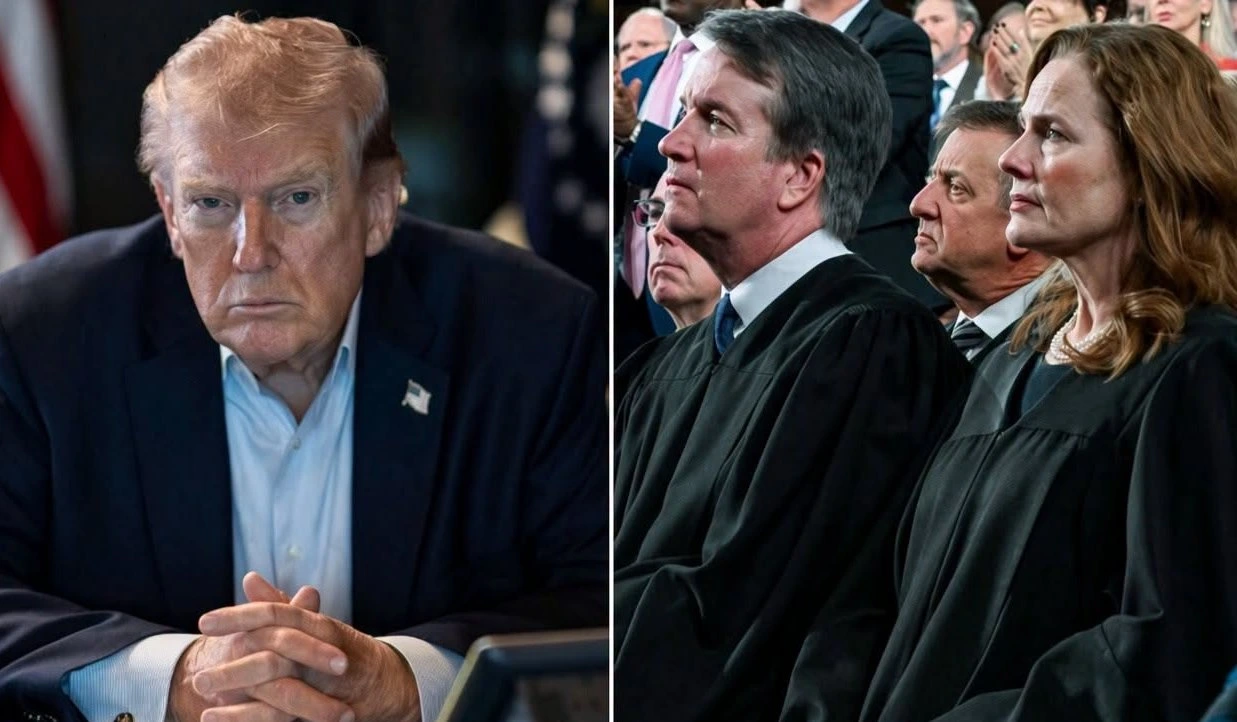
The Reaction
The unanimous decision marks a significant shift from lower courts’ approach to the speech restrictions. The justices’ order provides no explanation for the reversal, consistent with Supreme Court practice on summary decisions, leaving limited guidance on the constitutional questions raised by the immigration judges.
The ruling arrives as the Court also declined to hear a separate Trump petition this week. On Monday, the justices refused to take up the president’s bid to overturn a New York jury’s $5 million verdict finding him liable for sexual abuse and defamation in the case brought by writer E. Jean Carroll. The Court provided no rationale for declining the petition, a standard procedure when the high court turns away applications for review.
This marks the second time this year the Supreme Court has rejected Trump’s effort to erase the civil verdict. Carroll has postponed collection efforts during the extended appeals process. Trump’s legal team continues to contest a separate $83.3 million defamation award from a related trial, with lawyers asserting he is entitled to presidential immunity.
What This Means
The immigration judges ruling establishes that restrictions on official speaking engagements do not necessarily trigger First Amendment protections through federal court review, potentially affecting how federal employees across agencies navigate similar policies. The decision also reinforces the government’s ability to regulate employee speech in official contexts through existing civil service procedures rather than constitutional litigation.
Regarding the Carroll verdicts, the Supreme Court’s refusal to review the $5 million judgment leaves that finding intact and clears a pathway for Carroll to pursue collection after years of litigation. The $83.3 million defamation award remains under legal challenge, with the immunity question likely to determine the ultimate outcome. Both decisions reflect the Court’s posture on Trump-related cases as the political and legal landscape continues to shift.



